EU data residency and latency notes
If you ship LLM features to European users or operate under GDPR, you face a hard choice: route requests through a US-based API endpoint and accept higher latency across the continent, or use EU-hosted infrastructure and complicate your provider selection. This guide walks you through the trade-offs, measurement strategies, and practical steps to make that choice data-driven instead of guesswork.

Photo by Nataliya Vaitkevich from Pexels
If you ship LLM features to European users or operate under GDPR, you face a hard choice: route requests through a US-based API endpoint and accept higher latency across the continent, or use EU-hosted infrastructure and complicate your provider selection. This guide walks you through the trade-offs, measurement strategies, and practical steps to make that choice data-driven instead of guesswork.
TL;DR
- EU GDPR and data residency rules require data to remain in EU data centers, but "data" can mean different things (request bodies, training data, logs), clarify your legal requirements before choosing an endpoint.
- Latency from EU to US averages 100–150 ms TTFB (Time To First Byte); EU-native endpoints typically deliver 50–80 ms from major EU regions, a 40–60% improvement for chat-heavy workloads.
- Most major LLM providers (OpenAI, Anthropic) do not offer native EU endpoints; OpenRouter has regional backends, but coverage varies.
- Measure latency by region and model using Observinio's 21-region probes to find your real regional variance, not vendor averages.
- Data residency and latency are separate concerns, you can achieve GDPR compliance without accepting slow inference if you log and train outside the EU.
Understanding EU data residency rules

"Data residency" under GDPR does not mean all data processing must happen in the EU; it means personal data, name, email, user ID, chat history, cannot leave EU jurisdiction without explicit legal grounds. The distinction matters for API latency planning.
Most LLM API providers process your request in two phases:
- Request ingestion and routing, Where your prompt reaches first.
- Model inference and response generation, Where the actual compute happens.
The practical implication: If you are a strict GDPR interpreter or serve highly regulated customers (healthcare, finance, government), you must either:
- Use an EU-hosted LLM endpoint (which is rare and expensive).
- Accept that requests will route through a US endpoint and argue that the temporary processing is compliant under your Data Processing Agreement with the provider.
- Use on-premise models and avoid cloud inference altogether.
"Default choice: If you don't have strict regulatory or data residency requirements, and your team and/or customers are mostly in the Americas, choose the US data center.">, Regions and data residency
For most startups and mid-market teams, the second option, temporary US processing with a solid DPA, is acceptable. But if your customers are in Germany, Austria, or the financial sector, you may face pressure to prove that no personal data is stored or logged in the US. Check with your legal and compliance teams first.
Latency impact of regional choice

Latency is the speed penalty for choosing a distant endpoint. For chat applications, every millisecond matters: TTFB (Time To First Byte) below 500 ms feels instant; above 2 seconds, users abandon the interface.
Typical latency from EU to US endpoints
When you route a request from Frankfurt to OpenAI's US endpoint:
- Network round-trip (baseline): ~100 ms (transatlantic fiber, best case).
- OpenAI inference on US GPUs: ~200–600 ms (varies by model and load).
- Total TTFB: ~300–700 ms from Frankfurt.
Latency from EU-native endpoints
EU-hosted endpoints (where they exist) typically deliver:
- Network latency (Frankfurt to Frankfurt): ~5–10 ms.
- Model inference (EU GPUs): ~200–500 ms (same or slightly slower than US due to older hardware or lower scale).
- Total TTFB: ~205–510 ms from Frankfurt.
Where Observinio helps
Observinio probes 21 global regions and measures latency to OpenRouter and OpenAI direct endpoints. If you run Observinio's daily probes against both a US endpoint and an EU-routed backend (if your provider offers it), you can plot regional variance and set SLOs accordingly.
Example Observinio workflow:
- Set up probes to OpenRouter (which has EU backends) and OpenAI direct (US-only).
- Run daily pings from Dublin, Frankfurt, Amsterdam, and Eastern European regions.
- Compare TTFB histograms week-over-week to catch degradation (e.g., if your EU latency suddenly jumps 200 ms, investigate the provider or routing).
- Set alerts if Frankfurt TTFB exceeds 600 ms or if US-to-EU latency ratio exceeds 1.5x.
Provider landscape for EU access
Not all LLM providers offer EU endpoints. Here's the current state (as of 2025):
| Provider | US Endpoint | EU Endpoint | Notes |
|---|---|---|---|
| OpenAI | Yes (Oregon, Virginia) | No | Must route through US. Data travels to US on each request. |
| Anthropic | Yes (Virginia) | No | Must route through US. |
| OpenRouter | Yes | Yes (regional routing available) | Supports EU region selection; latency and cost may vary. |
| Azure OpenAI | Yes | Yes (EU datacenters available) | Requires Azure account and EU region setup; higher cost. |
| Google Vertex AI | Yes | Yes | Supports regional endpoints; GDPR-compliant option available. |
| Mistral AI | Yes | Yes (France) | Native EU option; lower latency from Europe. |
| Cohere | Yes | No | US-only at present. |
Measuring and monitoring regional latency

Vendor benchmarks and marketing claims often hide regional variance. Your users in Berlin may see 400 ms latency while your users in Dublin see 350 ms, but the provider's global average is 300 ms. Measure locally.
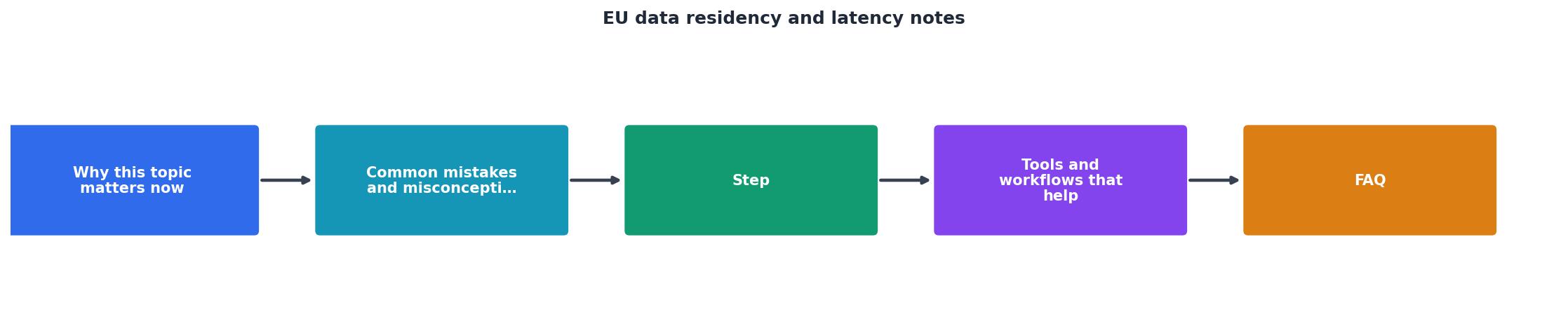
Step-by-step latency measurement checklist
Your progress is saved automatically in your browser.
Using Observinio for regional monitoring
Observinio sends probes from 21 regions, including Dublin, Frankfurt, Amsterdam, London, Stockholm, and Warsaw. Each day, Observinio fetches a completion from your endpoint and records:
- TTFB (milliseconds).
- Tokens per second (inference speed).
- Provider status (success or error).
- Timestamp and region (for trend analysis).
Making the provider choice: data residency vs. latency
When you have conflicting goals, GDPR compliance and low latency, you need a decision matrix.
Scenario 1: Startup with mostly US users, some EU
- Priority: Lowest cost and best overall latency.
- Choice: OpenAI direct (US endpoint). Argue that requests to US are compliant under DPA; you are not storing data there.
- Latency: ~500 ms from Frankfurt. Acceptable for most apps.
- Annual cost savings vs. Azure EU: ~$5,000–15,000 (depending on volume).
Scenario 2: B2B SaaS with EU enterprise customers
- Priority: GDPR compliance + acceptable latency.
- Choice: OpenRouter with EU routing, or Azure OpenAI EU region.
- Latency: ~300–400 ms from Frankfurt. Noticeable improvement over US.
- Annual cost premium: ~$8,000–20,000 vs. US endpoint (for mid-market volume).
Scenario 3: Financial services or healthcare in Germany
- Priority: Strict data residency (legal requirement).
- Choice: Mistral AI (France) or on-premise model.
- Latency: ~200–350 ms from Frankfurt (Mistral). Low if on-premise.
- Trade-off: Limited model choice. Mistral is strong for many use cases but does not match GPT-4 quality on all benchmarks.
Hybrid approaches: Decoupling data residency from inference
One often-overlooked strategy: separate the data pipeline from the inference endpoint. You can comply with GDPR without sacrificing latency.
Example workflow
- Ingest user data in EU (Frankfurt database). Comply with GDPR by design: data stays in EU.
- Anonymize or hash sensitive fields before sending to inference API (e.g., remove user ID, hash email). Now the request contains no personal data.
- Send anonymized request to US endpoint. No GDPR violation because there is no personal data in transit.
- Log inference results in EU (optional post-processing). You own the logs.
FAQ
Frequently Asked Questions
Next steps: Monitoring and alerting
If you decide to use a US endpoint for cost or model choice, monitoring regional latency variance is non-negotiable. Set up Observinio or a similar tool to catch the moment latency drifts above your SLO. A 50 ms latency regression per turn might seem trivial, but over a 10-turn conversation, it compounds to a noticeably slower chat.
For teams in strict GDPR regimes or with EU-only customers, start by mapping your real latency from EU regions to your current provider. Then run a 1-week trial with an EU-native endpoint (Mistral, Azure EU, or OpenRouter EU routing) and compare cost and latency. Often, the speed gain justifies the premium.
Observinio's 21-region probes and daily degradation alerts make it easy to catch regressions before users complain. Set a baseline SLO for each region, enable email alerts, and revisit your provider choice once a quarter. Data-driven decisions beat guesswork every time.
- Frankfurt to US: Expect 300–700 ms TTFB; set SLO at 600 ms for 95th percentile.
- Frankfurt to EU: Expect 200–510 ms TTFB; set SLO at 450 ms for 95th percentile.
- Eastern Europe to US: Expect 450–850 ms TTFB; set SLO at 800 ms for 95th percentile.
- Eastern Europe to EU: Expect 250–600 ms TTFB; set SLO at 550 ms for 95th percentile.
These targets assume standard LLM inference models; streaming APIs and smaller models may perform better.
Additional Resources
- Regions and data residency - Uniform Docs - The EU data center is ideal for customers who need to comply with European data privacy regulations, for latency and performance reasons.
- What Is Data Residency? Definition and Compliance - Understanding data localization vs data residency is critical: localization is a legal mandate, while residency can be a policy or contractual commitment.
- What is Data Residency? - Data residency refers to where organizational data is physically stored and legally governed. latency, or developer productivity.
Monitor AI API latency from 22 regions
Observinio runs daily probes against OpenRouter and OpenAI endpoints and emails you when latency degrades.
Set up alerts