
Photo by SM Mostafijur Nasim from Pexels
When you enable server-side rendering for a chat feature backed by OpenAI's API, every millisecond of latency lands squarely on the critical path of your page load. The server must call the chat completion endpoint, wait for at least the first token, and then flush HTML to the browser, all before the user sees anything meaningful. That makes regional latency variance far more than a dashboard curiosity: it directly shapes perceived performance for every visitor. In this article we break down the patterns we observe across 21 global probe regions, explain why SSR amplifies them, and give you a concrete playbook for keeping time-to-first-byte (TTFB) predictable.
TL;DR
- OpenAI chat completion latency can differ by 200–600 ms between the fastest and slowest probe regions, and SSR puts that delta on the critical rendering path.
- US-East regions consistently show the lowest TTFT (time-to-first-token); Asia-Pacific and South America see the widest variance windows.
- Streaming (
stream: true) reduces perceived SSR latency because you can flush partial HTML as tokens arrive. - Baseline comparison, not raw numbers, is the reliable way to detect regional degradation.
- Automated daily probes from multiple regions catch slow drifts that aggregate dashboards hide.
Why SSR makes regional latency matter more
In a typical client-side chat UI the browser fires the API call after the page has already rendered. The user sees a spinner, and latency is annoying but not blocking. With SSR the equation flips: the origin server calls OpenAI, waits for a response (or at least the first chunk), renders HTML, and only then sends bytes to the browser. The total TTFB your visitor experiences is roughly:
TTFB_visitor ≈ RTT_visitor_to_origin + RTT_origin_to_openai + OpenAI_processing + render_time
If your origin sits in us-east-1 and OpenAI's inference fleet is also US-East, RTT_origin_to_openai is small. But if your origin is in Frankfurt or Sydney, that round-trip alone can add 80–150 ms each way, and the chat completion endpoint typically requires multiple round-trips when you factor in TLS negotiation and token streaming setup. Multiply that by the number of sequential API calls some SSR pages make (system prompt warm-up, retrieval-augmented context fetch, final completion) and you can easily stack 300+ ms of pure network overhead on top of model inference time.
The compounding effect of sequential calls
Many SSR implementations follow a pattern like this:
- Fetch user context or session data from a database.
- Call an embedding endpoint for RAG retrieval.
- Call the chat completion endpoint with the retrieved context.
Patterns we see across 21 regions

Observinio runs daily synthetic probes against OpenAI chat completion endpoints from 21 global regions. Over time, several consistent patterns emerge:
1. US-East is the low-latency baseline
Probes originating from us-east-1 and us-east-2 consistently record the lowest TTFT values. This aligns with the widely held assumption that OpenAI's primary inference capacity is concentrated in US-East data centers. If your origin server is co-located in the same region, you benefit from sub-10 ms network hops to the API gateway.
2. Europe clusters around a predictable premium
Western European regions (Frankfurt, London, Paris) typically add a stable 80–120 ms premium over US-East baselines. This is almost entirely network RTT. The variance within Europe is low, the standard deviation across probes tends to stay under 30 ms, which means the penalty is predictable and can be budgeted for in your SSR timeout configuration.
3. Asia-Pacific shows the widest variance
Probes from Tokyo, Sydney, Mumbai, and Singapore show not only higher median latency but also significantly wider variance windows. A probe from Sydney might return in 320 ms on one run and 580 ms on the next. This variance likely reflects a combination of longer undersea cable paths, variable peering quality, and potential routing through intermediate PoPs. For SSR applications serving APAC users, this unpredictability is the real problem, it makes timeout tuning and cache-warming strategies much harder.
4. South America and Africa are outliers
Regions like São Paulo and Cape Town frequently record the highest absolute latencies and the most frequent timeout events. If you are SSR-rendering chat features for users in these regions, you should seriously consider edge caching strategies or moving the API call to the client side for those geographies.
5. Weekend and off-peak patterns exist but are subtle
We observe slightly lower median latencies during US weekend hours, consistent with reduced load on OpenAI's inference fleet. The difference is typically 30–60 ms, meaningful for SSR but easy to miss in weekly aggregate reports.
How to measure regional latency properly
Raw latency numbers are useful, but baseline comparison is what turns data into actionable signals. A 400 ms TTFT from Sydney means nothing in isolation, you need to know whether that is normal for Sydney or a 2× regression from last week. Here is a step-by-step approach to building reliable regional baselines:
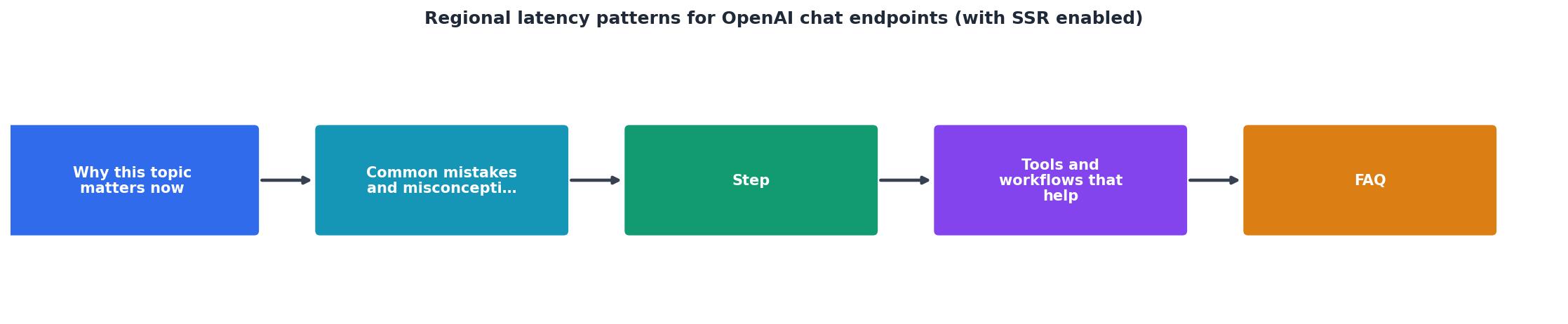
- Select representative regions. Pick at least five regions that match your actual user distribution. If 60 % of your traffic is US-East but 15 % is Western Europe and 10 % is APAC, probe from at least two US, two EU, and two APAC locations.
- Use a consistent probe payload. Your synthetic request should mirror a real SSR call: same model, similar token count in the prompt,
stream: trueif that is what your production code uses. Varying the payload between probes introduces noise that masks real regional differences. - Probe at regular intervals. Daily probes are the minimum cadence for catching slow drifts. Hourly probes are better if you need to detect intra-day patterns (e.g., US business-hours congestion).
- Record TTFT, not just total response time. For streaming SSR, the metric that matters most is time-to-first-token, that is when your server can start flushing HTML. Total response time matters for non-streaming calls, but TTFT is the SSR-critical metric.
- Compute rolling baselines per region. A 7-day rolling median per region gives you a stable baseline. Flag any probe that exceeds 1.5× the baseline as a potential degradation event.
- Set up automated alerts. Manual dashboard checks do not scale. Configure alerts that fire when a region's latency crosses its baseline threshold for two or more consecutive probes.
Practical checklist: optimizing SSR latency with OpenAI endpoints
Use this checklist to audit your current SSR setup:
Your progress is saved automatically in your browser.
Example: streaming flush in a Node.js SSR handler
app.get('/chat', async (req, res) => {
  res.setHeader('Content-Type', 'text/html; charset=utf-8');
  res.setHeader('Transfer-Encoding', 'chunked');

// Flush the HTML shell immediately
  res.write('<!DOCTYPE html><html><body><div id="chat">');

const stream = await openai.chat.completions.create({
    model: 'gpt-4o',
    messages: [{ role: 'user', content: req.query.q }],
    stream: true,
  });

for await (const chunk of stream) {
    const text = chunk.choices[0]?.delta?.content || '';
    // Flush each token as an HTML text node
    res.write(escapeHtml(text));
  }

res.write('</div></body></html>');
  res.end();
});
This pattern ensures the browser starts receiving bytes as soon as the first token arrives from OpenAI, rather than waiting for the entire completion. The TTFB the user experiences drops from RTT + full_inference_time to RTT + TTFT, which can be a difference of several seconds for longer completions.
| Mode | TTFB formula | Typical TTFB (US-East origin) |
|---|---|---|
| Non-streaming SSR | RTT + full inference time + render | 2 000–10 000 ms |
| Streaming SSR | RTT + TTFT | 150–450 ms |
| Client-side (post-hydration) | Page TTFB unaffected; chat latency after interaction | 0 ms (page), 150–450 ms (chat) |
When to move the API call client-side
SSR is not always the right choice for chat endpoints. Consider switching to client-side rendering when:
- The completion is long. If the expected output is hundreds of tokens, streaming to the browser directly via a client-side
EventSourceorfetchwithReadableStreamgives a better UX than holding the SSR response open. - The user is in a high-latency region. If your probes show that APAC or South American TTFT consistently exceeds your TTFB budget, serve a static shell via SSR and hydrate the chat client-side.
- The call is not SEO-critical. If search engines do not need to see the chat output, there is no SEO benefit to SSR-rendering it.
Frequently Asked Questions
stream: true, your server can flush the first HTML bytes as soon as the first token arrives, which is typically within 100–400 ms of the request. Without streaming, the server must wait for the entire completion (potentially 2–10 seconds for longer outputs) before it can send any HTML. For SSR, this difference is critical.Stay ahead of regional latency shifts
Regional latency patterns are not static, they shift as OpenAI scales infrastructure, as network peering arrangements change, and as traffic patterns evolve. Catching a slow drift in your APAC latency before it becomes a user-facing incident requires continuous, automated monitoring from the regions that matter to your product. Observinio probes OpenAI and OpenRouter endpoints from 21 regions daily, compares results against rolling baselines, and sends you email alerts when degradation is detected. Check the status page for a live view, or visit the OpenRouter provider page to compare routing options across regions.
Additional Resources
- OpenAI API Reference: Chat Completions - Official documentation for the chat completions endpoint, including streaming parameters and response format details.
- web.dev: Time to First Byte (TTFB) - Google's guide to understanding and optimizing TTFB, the core metric affected by SSR latency on the critical rendering path.
- Vercel: Streaming SSR with Edge Functions - Practical guide to implementing streaming server-side rendering at the edge, directly applicable to reducing OpenAI API latency in SSR pipelines.