
Photo by SM Mostafijur Nasim from Pexels
Every time OpenAI ships a major model version, think the jump from gpt-4-0613 to gpt-4-turbo, or from gpt-4o to gpt-4o-2024-08-06, teams running production chat features notice something uncomfortable: latency baselines shift, and they shift unevenly across regions. A model that was comfortably under 800 ms TTFB from us-east-1 might suddenly spike to 1 200 ms from eu-west-1 for the first two weeks after a rollout. If you are routing real user traffic through these endpoints, understanding the regional shape of those regressions is the difference between a smooth migration and a week of firefighting.
TL;DR
- Major OpenAI model version upgrades consistently introduce a transient latency increase that is not uniform across regions, some regions recover in days, others take weeks.
- TTFB (Time to First Byte) and TTFT (Time to First Token) are the two metrics that diverge most during rollout windows; median latency often hides the problem.
- Asia-Pacific and South America regions historically see the longest stabilization periods after a version bump.
- Proactive monitoring from multiple geographic vantage points is the only reliable way to catch these regressions before users report them.
- Establishing per-region baselines before a migration lets you set meaningful SLO thresholds and trigger alerts automatically.
Why major version upgrades change the latency landscape

OpenAI does not publicly document the infrastructure changes that accompany a major model release, but the observable effects are consistent enough to reason about. When a new model version goes generally available, several things happen simultaneously:
- Capacity rebalancing. Inference capacity is redistributed across data centers. Regions closest to OpenAI's primary compute clusters (US East, US West) tend to get priority allocation, while traffic routed through edge PoPs to more distant regions may temporarily hit capacity limits and queue.
- New model weights and serving infrastructure. A major version often ships with architectural changes, different context window sizes, new tokenizer behavior, or updated system prompt handling. These changes can alter the compute profile per request, meaning old latency baselines no longer apply.
- Gradual rollout and traffic shifting. OpenAI frequently rolls out new versions progressively. During the transition window, some requests may be served by the new version and others by the old, creating bimodal latency distributions that are invisible in simple averages.
- Cache invalidation effects. KV-cache and prompt-cache optimizations that were tuned for the previous model version may not transfer. The first wave of requests on a new version is effectively "cold," and cold-start penalties vary by region depending on local cache infrastructure.
"Generally available models: At least 6 months (notice).">, Serious latency issues while migrating from GPT
This deprecation notice window gives teams time to plan, but it says nothing about the latency characteristics of the replacement model. The notice guarantees availability, not performance parity.
Regional patterns we observe repeatedly

Based on continuous synthetic probing from 21 global regions, several patterns emerge after each major OpenAI chat endpoint upgrade:
Pattern 1: US regions recover first
Regions in the continental United States, particularly US East and US West, typically show the smallest TTFB increase (often under 15% above baseline) and return to stable performance within three to five days. This aligns with the assumption that OpenAI's primary inference clusters are US-based.
Pattern 2: Europe follows with a lag
Western European regions (eu-west-1, eu-central-1) usually see a 20–40% TTFB increase in the first 48 hours. Stabilization takes roughly five to ten days. Eastern European and Nordic regions can take slightly longer, likely due to additional network hops.
Pattern 3: Asia-Pacific and South America experience the widest variance
Regions like ap-southeast-1 (Singapore), ap-northeast-1 (Tokyo), and sa-east-1 (São Paulo) consistently show the highest post-upgrade latency spikes, sometimes exceeding 60% above baseline, and the longest stabilization windows, often two to three weeks. P95 and P99 latency in these regions can be dramatically worse than the median, making tail-latency monitoring essential.
Pattern 4: TTFT diverges from TTFB
During upgrade windows, Time to First Token (the moment the streaming response begins producing output) often degrades more than raw TTFB. This suggests that the inference pipeline itself is slower, not just the network path. For streaming chat applications, TTFT is the metric users actually feel, so monitoring it separately from TTFB is critical.
Pattern 5: Weekday traffic amplifies the effect
Post-upgrade latency regressions are most pronounced during weekday peak hours (14:00–22:00 UTC). Weekend probes often show near-baseline performance, which can create a false sense of recovery if you only check dashboards on Saturday morning.
A step-by-step playbook for version migration monitoring
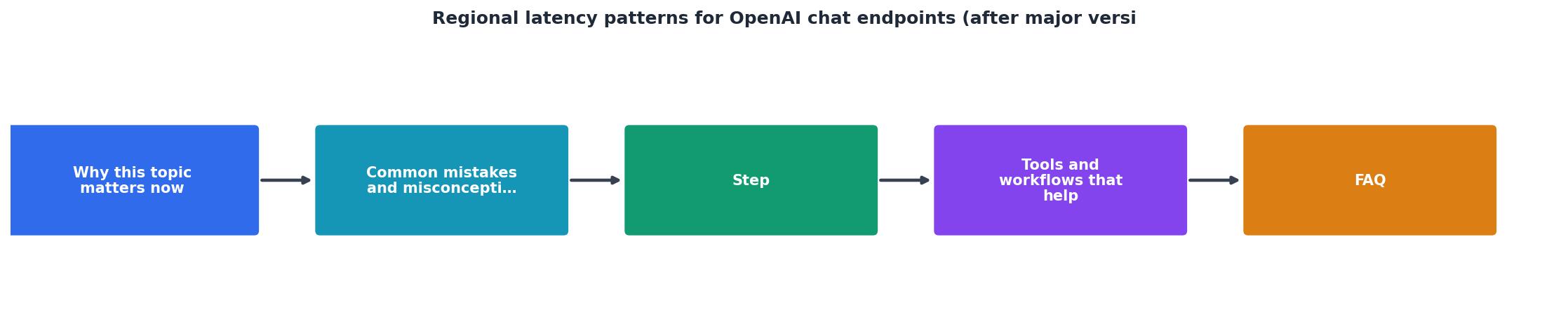
Use this process every time OpenAI announces a new generally available model version that you plan to adopt:
- Capture your current baseline (week −2 to week −1). Before switching model versions, record TTFB and TTFT from every region you serve users in. Use at least seven days of data to account for weekday/weekend variance. Store P50, P90, P95, and P99 values per region.
- Define per-region SLO thresholds. Set acceptable degradation limits for each region. A reasonable starting point: alert if P90 TTFB exceeds 130% of the baseline for more than two consecutive probe cycles. Tighter thresholds for your primary user regions, looser for secondary ones.
- Deploy the new model version to a canary path first. If your architecture supports it, route 5–10% of traffic to the new model version while keeping the rest on the old one. Compare latency side by side from the same regions.
- Monitor daily for the first 14 days post-switch. Do not rely on a single "looks good" check after 48 hours. Regional stabilization is gradual and non-linear. Pay special attention to Asia-Pacific and South America if you have users there.
- Compare against Observinio's daily probes. Cross-reference your internal metrics with external synthetic probes to distinguish between provider-side regressions and issues in your own stack (network, middleware, prompt construction).
- Document the migration timeline. Record when each region returned to baseline. This historical data becomes invaluable for planning the next migration, you will know which regions need extra runway and which can be switched aggressively.
Practical checklist: what to monitor during an OpenAI version upgrade
Use this checklist as a quick reference for your on-call team or platform engineers:
Your progress is saved automatically in your browser.
Reading the data: what P50 hides and P95 reveals
One of the most common mistakes during a version migration is relying on median (P50) latency as the primary health signal. During a stable period, P50 and P95 tend to track each other proportionally. After a major version upgrade, they often decouple.
Consider a concrete scenario: your eu-west-1 probe shows P50 TTFB of 650 ms (only 8% above baseline), so the dashboard looks green. But P95 is at 1 800 ms, a 90% increase. What is happening? A fraction of requests are hitting cold inference paths or being queued behind capacity limits, and those requests are the ones your most latency-sensitive users experience. If your alerting is based on P50, you will miss this entirely.
The fix is straightforward: always set alerts on P90 or P95, and review P99 manually during migration windows. Observinio's weekly summary emails include percentile breakdowns per region, which makes this review a five-minute task rather than a dashboard deep-dive.
When to delay a migration
Not every version upgrade needs to happen on day one. Here are concrete signals that suggest you should wait:
- P95 TTFB from your primary region exceeds 150% of baseline after the first 72 hours of the new version being GA. This suggests capacity is still being provisioned.
- Error rates (429/503) increase by more than 2x in any region you serve production traffic from. Rate limit increases often accompany new model launches as demand surges.
- OpenAI's own status page shows active incidents related to the new model. Check status.openai.com and cross-reference with Observinio's status page for independent confirmation.
- Your canary deployment shows bimodal latency with a clear slow cluster. This indicates inconsistent serving infrastructure that has not fully stabilized.
| Region | Typical TTFB spike | Days to stabilize | Risk level |
|---|---|---|---|
| US East / US West | < 15 % | 3 – 5 | Low |
| EU West / EU Central | 20 – 40 % | 5 – 10 | Medium |
| AP Southeast / AP Northeast | 40 – 60 %+ | 14 – 21 | High |
| SA East (São Paulo) | 40 – 60 %+ | 14 – 21 | High |
FAQ
Frequently Asked Questions
Stay ahead of the next upgrade
Regional latency regressions after model version upgrades are predictable in shape, even if the exact magnitude varies each time. The teams that handle them well are the ones with per-region baselines already in place and alerts configured before the switch happens. Observinio's daily probes from 21 regions, combined with automatic degradation alerts and weekly summary emails, give you exactly that visibility, without building a custom monitoring stack. Set up your baselines now at observinio.com so the next OpenAI version bump is a data point, not a fire drill.
Additional Resources
- Serious latency issues while migrating from GPT-4o - API - Gpt-5 series models have serious latency issues since they are reasoning models, and we do not need so much of reasoning. Generally available ...
- Stateful Responses API Much Slower Than Chat ... - Responses API (AzureOpenAI) is significantly slower on average than the Chat Completions endpoint. Occasionally some Responses requests have ...
- High latency for chat completion requests to Azure OpenAI ... - I have a deployment of gpt-4o-mini 2024-07-18 in region swedencentral and started to encounter high latency around 7:38 AM GMT on 2025/11/13. The request ...