
Photo by Google DeepMind from Pexels
When you ship a chat feature or completion-based product powered by OpenAI, your users don't care about your infrastructure. They care whether their request completes in a reasonable time. That time isn't just about OpenAI's model latency, it's about their own network, your routing layer, regional variance, and a hundred other variables. Without explicit Service Level Objectives (SLOs) tied to measurable latency metrics, you're flying blind.
TL;DR
- SLOs for OpenAI-powered features must measure Time-to-First-Byte (TTFB) and Time-to-First-Token (TTFT), not just uptime.
- Regional latency variance is real: OpenAI endpoints respond faster from some geographic regions than others; you need baseline data.
- Set SLO targets based on your use case: chat interfaces need TTFB <800 ms; completions can tolerate slightly higher latency if response throughput is good.
- Monitor from multiple regions with daily synthetic probes; detect degradation before users complain.
- Alert on breach and trend, not just threshold crossing; a 2× spike matters even if absolute latency stays "acceptable."
Why SLOs matter for LLM APIs

Most teams monitor uptime, the binary: is the API up or down? But OpenAI rarely goes fully down. What breaks user experience is latency creep. A completion that used to arrive in 200 ms now takes 800 ms. Users abandon the request. Support tickets flood in. You debug for days, only to discover OpenAI had a regional capacity issue three hours ago that's already resolved.
SLOs force you to define what "working" actually means quantitatively. Not "we expect fast responses", but "99% of requests will return a first token within 1.5 seconds, measured from all 21 regions we serve." That specificity is effective:
- It drives decision-making. When you know your SLO, you can compare OpenAI direct vs. OpenRouter, or GPT-4 vs. GPT-4o, with real latency data instead of guesswork.
- It enables early detection. Daily probes from multiple regions let you catch regional degradation hours before your customers in Tokyo or Berlin notice.
- It justifies investment. SLO breaches give you hard numbers for the business case to switch providers, add retry logic, or invest in caching.
"It's no longer about whether you can build, but what you build and how it stands out.">, ChatGPT Work for Design teams
Latency metrics that actually matter

Not all latency metrics are created equal. If you're measuring only end-to-end completion time (TTLC, time-to-last-character), you'll miss the story. Here are the metrics that matter:
- Time-to-First-Byte (TTFB): How long from your request leaving your client until the first response byte arrives. This is what users feel when they wait for a typing indicator to appear.
- Time-to-First-Token (TTFT): How long until OpenAI returns the first token of the completion. For chat, this is critical, it signals that generation has begun. A high TTFT kills perceived performance even if throughput is good.
- Token throughput: Tokens per second after the first token arrives. A 5-second TTFT is painful, but if the model then streams 50 tokens/second, the total time is still acceptable. A 200 ms TTFT with only 2 tokens/second is worse.
- Percentile latency (p50, p95, p99): Average latency hides outliers. If your p50 TTFB is 150 ms but p99 is 3 seconds, half your users have a great experience and half have a terrible one. Set SLOs on percentiles, not averages.
- Regional variance: OpenAI has infrastructure in multiple regions. A request from São Paulo may see 450 ms TTFB, but the same request from Tokyo might be 950 ms. Your SLO must account for this or you'll constantly breach it in distant regions.
Designing SLOs for different use cases

The right SLO depends on your product. A real-time chat interface has different latency demands than a background job that generates bulk summaries.
Interactive chat and search
For chat interfaces, users are actively waiting. Latency directly affects perceived responsiveness and engagement. Recommended SLOs:
- TTFB p99 < 800 ms (across all regions)
- TTFT p95 < 1.2 seconds
- Availability: 99.5% (account for regional variance and temporary OpenAI blips)
Bulk processing and batch completions
For non-interactive workloads, you have more tolerance for latency, but throughput matters. Recommended SLOs:
- TTFB p99 < 3 seconds (acceptable since the user isn't waiting synchronously)
- Batch completion rate: 95% within 30 minutes
- Per-token latency: >= 10 tokens/second (to keep total time predictable)
Hybrid: Real-time with fallback
Many products combine real-time requests with cached or fallback responses. Your SLO might be:
- Fresh response TTFB p99 < 1 second
- Fallback/cache response: 99.99% hit rate (your safety net when OpenAI is slow)
Setting baselines and alert thresholds
Before you set an SLO, you need a baseline. Run Observinio daily probes for two weeks across all 21 regions. Record TTFB, TTFT, and p99 values. Then:
- Calculate the p99 for each region. Don't average regions; you'll hide regional variance.
- Set your SLO at approximately the current p95–p97. This is achievable most of the time but tight enough to catch real degradation.
- Set an alert threshold at 1.5× baseline p99. A 2× spike is almost always actionable; a 1.2× spike is noise.
- Monitor weekly trends. If p99 TTFB has crept up 150 ms over three weeks, investigate now, before you breach SLO.
Practical alert checklist
Your progress is saved automatically in your browser.
From SLO to incident response
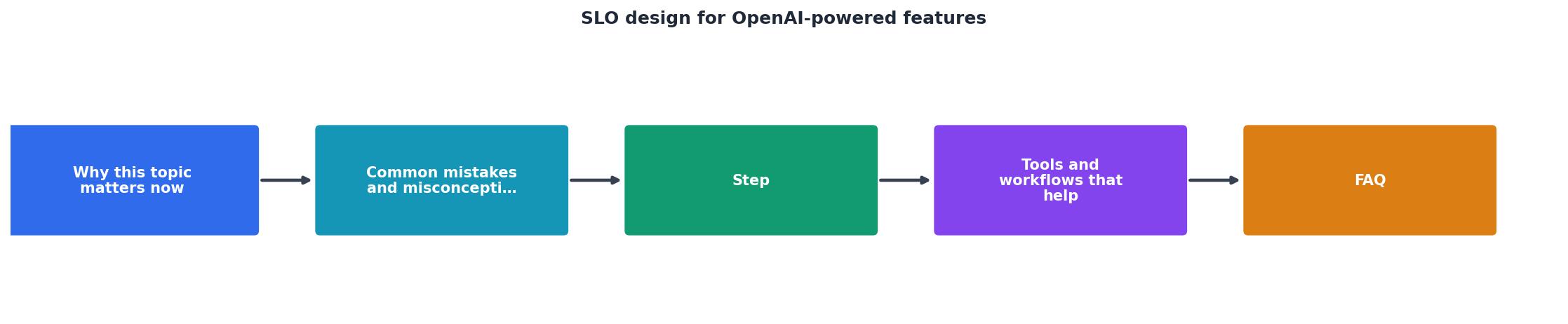
Once you have SLOs and monitoring in place, the next step is translating breaches into action. Here's a workflow:
- Alert fires: Observinio detects p99 TTFB has spiked 60% above baseline in the EU region.
- Triage: On-call engineer checks whether the spike is global or regional. Observinio's 21-region baseline makes this instant.
- Decision point: If it's regional and brief (<5 minutes), you might accept the breach. If it's global or sustained, escalate.
- Response options:
- Switch to OpenRouter (if you have fallback routing configured)
- Degrade gracefully (use cached responses or a simpler model)
- Page the oncall SRE and start incident investigation
- Postmortem: Weekly summary from Observinio shows you latency trends. If you breached SLO three times in one week, you know you need to revisit your SLO or your architecture.
Avoiding common pitfalls
Pitfall 1: Setting SLOs too tight. If your p99 baseline is 1.2 seconds and you set an SLO of 800 ms, you're guaranteed to breach constantly. Your team will ignore alerts. Set SLOs at achievable levels, then improve your stack to tighten them.
Pitfall 2: Forgetting regional variance. A global SLO of "p99 < 1 second" sounds great, but if your API gateway adds 200 ms and OpenAI adds 600 ms in Southeast Asia, you're already breaching before any user request arrives. Account for your infrastructure, not just the provider.
Pitfall 3: Measuring from a single region. If you only probe from US East, you won't detect that your API is broken for 30% of your user base in Europe. Observinio's multi-region probes are specifically designed to catch this.
Pitfall 4: Ignoring token throughput. A 200 ms TTFB followed by 1 token/second throughput is worse than a 500 ms TTFB followed by 20 tokens/second. Measure the full pipeline.
FAQ
Frequently Asked Questions
Next steps
If you're shipping OpenAI-powered features, start measuring today. Use Observinio to collect baseline data from at least 3 regions for two weeks. Calculate your p99 TTFB and TTFT, then set SLO targets at the p95 level. Configure alerts for a 1.5× deviation from rolling baseline, and track regional variance separately.
Once your SLOs are defined and alerts are firing, you'll have the data to make provider and routing decisions with confidence, and you'll know about problems before your customers do. Check out Observinio's status page to see live latency data across 21 regions, or explore provider-specific monitoring to compare OpenRouter and direct OpenAI endpoints. Ready to get started? Contact us for a walkthrough of regional SLO setup.
Quick SLO Reference for LLM APIs
• TTFB p99: <800ms
• TTFT p95: <1.2s
• Availability: 99.5%
• TTFB p99: <3s
• Completion rate: 95% in 30m
• Throughput: ≥10 tokens/s
Baseline these metrics daily across all regions, then set SLO targets at the p95 level to balance achievability with tight monitoring.
Additional Resources
- ChatGPT Work for Design teams - Use ChatGPT Work to turn product surfaces, briefs, and feedback into prototypes, templates, audits, and clear next steps for design teams.
- OpenAI Agent SDK Features, Tools and Developer Insights - This openai agent sdk review breaks down every key feature for building AI agents.
- Try Codex with ChatGPT paid plans. | OpenAI - It features a built-in touchscreen for mapping. The app can automate bug fixing, dark mode access, background tasks, and collaborative settings ...